What happens when inclusion is a required field, not a policy
When we were building Scale’s supplier onboarding flow, Comark, Brian and I had an argument about one field. The field was ownership type. Women-owned, youth-owned, persons-with-disabilities-owned. The argument was simple: should it be required or optional? The case for optional was reasonable. You do not want to add friction at
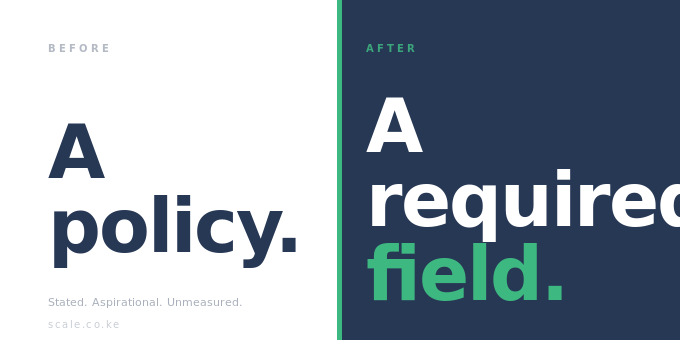


When we were building Scale’s supplier onboarding flow, Comark, Brian and I had an argument about one field.
The field was ownership type. Women-owned, youth-owned, persons-with-disabilities-owned. The argument was simple: should it be required or optional?
The case for optional was reasonable. You do not want to add friction at onboarding for a small business already nervous about joining a new platform. Make it optional. Collect what you can. Layer it in properly later.
The case for required was also reasonable. An optional field in a supplier database fills at maybe 20 to 40 percent. A required field fills at close to 100 percent. And if you cannot answer the basic question – what share of our supplier base is women-owned? – because the data simply does not exist, then every other question about inclusive procurement is also unanswerable. You cannot report a number you have never collected. You cannot improve a baseline you do not have.
We made it required.
Not because of a policy commitment or a grant condition or an ESG framework. Because optional fields are where intentions go to become unusable data.
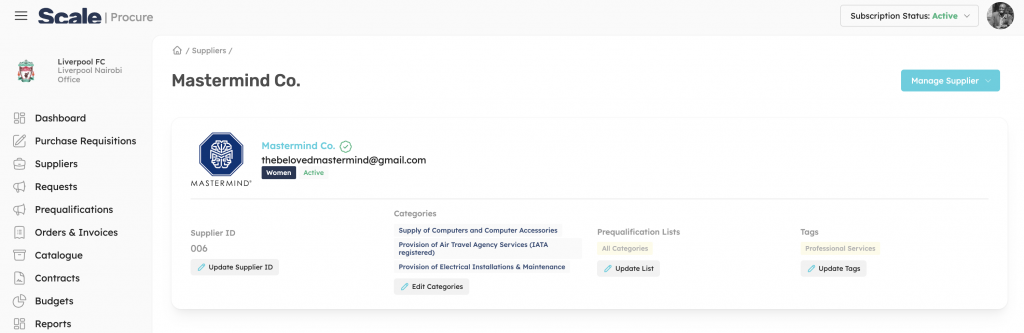
We put ownership type first in the supplier record. Before category. Before spend tier. Before anything else. The sequence is deliberate: who this supplier is comes before what they sell.
That decision was made early in the build, and we did not fully understand what it would produce until we started running prequalification exercises on behalf of clients.
Here is how prequalification works. An organisation asks Scale to run their supplier prequalification – to build and manage the process of vetting, onboarding, and classifying their supplier base. We do it. We collect the data, we run the exercise, we build the register. And when the prequalification report is ready, we present it to the procurement team.
Nobody briefs us on inclusion targets. Nobody asks us to apply diversity parameters. That is not part of the commission. We are asked to run a rigorous prequalification. So we do – and because ownership type is a required field in our system, the inclusion data comes out automatically, as part of the standard output.
That is the moment things get interesting.
I have been in enough of those rooms now to know what happens when procurement teams see the numbers for the first time. The percentage of women-owned suppliers in the database appears on screen. Then the percentage of youth-owned. Then persons with disabilities. There is a pause – longer than you would expect. And then something that is not quite embarrassment and not quite surprise, but sits somewhere between the two.
They were not expecting to see it. And they were not expecting the number to be that high.
Across two recent prequalifications Scale ran for enterprise clients in Kenya – different sectors, different buyers, completely different supplier pools – 54% of all prequalified suppliers were from preferential ownership groups. More than half. In one exercise, 36% of the entire prequalified base was women-owned, exceeding Kenya’s AGPO 30% target. Neither client had set an inclusion target. Neither had asked us to find them inclusive suppliers. The system produced this because ownership type is a required field, captured at the point of entry, for every supplier who comes through.
That is when inclusion stops being aspirational and starts being operational. Not a policy statement on a website. A number, on a page, in a report they commissioned – that they can now actually use.
That is why we built it into the onboarding by design. Not because every client asks for it. Because every client needs it, whether they asked or not.
I want to be honest about what the required field actually does.
It did not change how many women-owned businesses win contracts. It did not close a payment gap or fix a prequalification requirement. It did one thing: it made the problem countable. And countable is where change starts, because you cannot set a real target from a guess.
What Scale now produces from that single required field is a live view of the supplier register by ownership type, a running track of how many tenders reached women-owned suppliers each quarter and what those contracts were worth in KES, and a scorecard benchmarked against the AGPO 30 percent target and GRI Standard 414. The data is a by-product of running procurement through the platform. No separate reporting form. No annual survey. The numbers appear because the procurement happened, inside a system that was built to know who it was buying from.
That is the thing that still surprises me most. The biggest barrier most organisations face on supplier diversity is not attitude. It is not budget. It is that their procurement system was built to pay suppliers, not to understand them. The data they need does not exist, because nobody decided it should.
We decided it should. One field. Required.
The self-assessment tool at www.scale.co.ke/supplier-inclusion asks the question directly: can your organisation actually answer what share of last year’s procurement spend reached women-owned businesses? It takes eight minutes. It covers supplier classification, what you can report on awards and value, payment terms comparison across supplier groups, and what your board currently sees.
Most organisations that complete it score in the Reactive or Aware range. That is where most procurement systems honestly sit – not because of bad intentions, but because the field was optional.
If you want to know your number before someone asks you for it, the assessment is a good place to start.
“When the numbers are hidden, you can hide behind them. But now that they are in your graphs and anybody can see it – from the CEO to all the people doing requisitions – it actually inspires action.” – Marvin