You Can See Every Shilling of Revenue. Can You See What You Buy?
On a continent that has spent a decade digitising the sell side, the buy side still runs on paper, email and memory.



Walk into almost any boardroom on the continent and you will find a chief executive who can tell you, to the shilling, what came in last month. Revenue is tracked in real time because the sales pipelines are dashboards and customer behaviour is instrumented to the click. We have spent a decade and a great deal of capital digitising the side of the business where money arrives.
Now ask the same executive a different question: what did the company actually buy last month, from whom, and was it the right price? In most organisations, the honest answer is a shrug — a scramble through email threads, spreadsheets, and a few people’s memories. The buy side of African business still runs on paper, relationships, and approval queues that would be familiar in 1995.
This is the quiet frontier. While we celebrate mobile money and consumer fintech (deservedly), the larger and less glamorous flows of corporate capital move through procurement, and that function remains the most analogue part of the enterprise. The opportunity hiding there is not a back-office efficiency play. It is margin, it is resilience, and increasingly it is the only credible way to prove the inclusion commitments that boards and investors now demand.
Why we look away
Procurement gets ignored for a simple reason; it is unglamorous and inward-facing. Digital investment chases the customer (i.e. sales, experience, payments, marketing) because that is where growth feels visible or tangible. Procurement is treated as plumbing, basically a cost centre to be contained rather than a lever to be pulled.
The numbers say otherwise. Bain & Company’s analysis shows that procurement is, for many companies, the single largest controllable line on the page, yet some global benchmarking finds that the best procurement functions keep watch over almost all of their company’s spend, while typical firms track far less. The gap between them is money leaving the building unnoticed.
As usual, our continent tends to compound the problem. A World Bank study of African firms found that most businesses which adopt digital technology never use it intensively; the tools are bought and then left idle. A Deloitte global chief procurement officer survey captured the same tension everywhere: most procurement leaders call digital transformation a priority, yet only a minority have actually adopted the tools. Clearly the intent is very much universal, while the execution proves to be rare.
Where the leverage actually is
Digitising procurement has never been about replacing a paper-based requisition with a scanned PDF. If done seriously, it pays out along three lines that any African executive should care about.
1. Margin
Procurement can be considered one of the fastest routes to profit that does not require selling a single additional unit. Ardent Partners’ research suggests that every new dollar of spend brought under proper procurement management yields between 6% and 12% in savings. When purchasing is often the single largest controllable cost a company carries, even modest discipline on that base falls almost entirely to the bottom line – a far cheaper margin than chasing equivalent growth in a competitive market.
The mechanism is visibility. The average organisation actively manages only part of its spend; the rest leaks out as uncontrolled, off-contract “maverick” buying – duplicate suppliers, missed volume discounts, prices no one negotiated. Procurement teams cannot squeeze a cost they cannot see. If well consolidated, analysed spend data is the negotiating leverage most firms already own and never use.
2. Resilience and control
This is where procurement stops being a finance story and becomes a survival one. Africa’s trade structure leaves businesses unusually exposed: manufactured goods dominate the continent’s imports, while exports remain concentrated in commodities, tying input costs to global price swings and currency volatility. Intra-African trade remains strikingly low, far below the levels long seen in Europe or Asia. When a shock hits, for example a pandemic, a war or a freight crisis, firms dependent on a thin band of distant suppliers discover how fragile their supply lines really are.
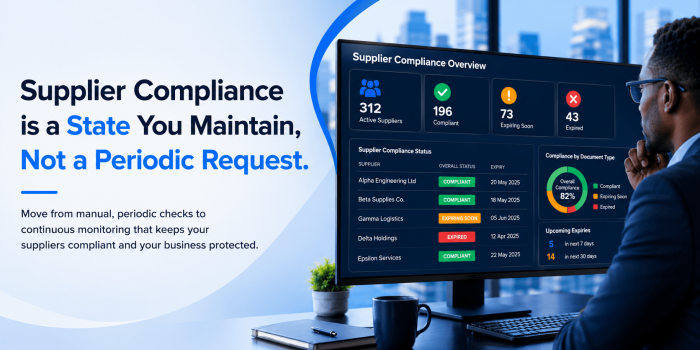
A digital procurement system is, in effect, a risk map. It shows you supplier concentration, single points of failure, and where currency exposure is buried in your input costs. As the African Continental Free Trade Area gradually lowers the barriers to sourcing within the continent, the firms positioned to act will be the ones who can actually see their supplier base well enough to diversify it. Afreximbank expects that trade to keep rising as the bloc matures, and capturing a share of that shift is a data problem before it is a sourcing one.
3. Inclusion as a measurable capability
Here is the pillar most procurement-transformation writing misses, and the one African executives increasingly cannot avoid. ESG mandates, supplier-diversity targets, local-content rules, and preferential procurement all share a single weakness: you cannot report what you cannot see.
A strong empowerment score is now often required to win contracts (public and private alike) and multinationals operating on the continent increasingly fold supplier diversity into their ESG and sustainability reporting. Under the codes of South Africa’s B-BBEE framework, for example, preferential-procurement recognition only counts when a supplier’s empowerment status can be tied to actual invoices and payments, with valid, in-date certification. Miss the paperwork and the credit evaporates, no matter how good your intentions. Administration, in other words, is the whole game; and administration is exactly what digital systems do well.
This reframes inclusion from a soft commitment into a hard capability. When supplier classification (local, women-owned, small enterprise, empowerment status) is captured at the point of every transaction rather than reconstructed painfully at year-end, “we spend X% with diverse suppliers” stops being an aspiration in a press release and becomes an auditable, board-ready, lender-ready metric. Spend that broadens participation becomes a measurable inclusion lever. For firms answering to development-finance covenants, multinational parents, or local-content regulators, that is not goodwill. It is access to capital and the right to operate.
The honest barriers
If the case is this strong, why hasn’t it happened? Partly the familiar obstacles: legacy systems, fragmented data, patchy connectivity, and the genuine difficulty of changing how people work. But the uncomfortable private-sector truth is that procurement stays under-invested precisely because it is misread as a cost to contain rather than value to create; therefore, it never reaches the front of the digital queue. And entrenched manual processes and long-standing supplier relationships can quietly shelter both inefficiency and the occasional conflict of interest. Opacity is comfortable for someone. Naming that is the difference between a transformation and a software purchase.
What “done well” looks like
Through our work building and deploying Scale procurement technology across African markets, the pattern that separates success from expensive disappointment is consistent.
- Do not digitise the paper. Lifting a broken manual process onto a screen simply makes it broken and faster. The point is to rethink the workflow, not photograph it.
- Treat spend data as a strategic asset, not a record. The reporting is the product — the dashboard that tells the CFO what the company buys and the board whether the inclusion targets are being met.
- Design supplier onboarding to widen the base, not fortify the gate. The same digitisation that delivers efficiency can either lock out smaller and local suppliers through complexity, or – done deliberately – bring them in. That choice is a design decision, and it is where the inclusion and resilience pillars converge.
- Build interoperability with finance and ERP systems, and capture ESG and preferential-spend classification at source. Bolting it on afterward never works.
- Treat change management as the real project. The technology is rarely the bottleneck; the habits around it always are. The leaders at the recent digital procurement event put it bluntly: “In a world that demands resilience, speed, and agility, firms that refuse to adapt their procurement will simply be overtaken by those that do.”
The mandate for Africa’s C-Suite Leaders
So the ask for the African C-suite is straightforward. Stop treating procurement as plumbing and move it onto the transformation agenda where it belongs. Demand real visibility into what your organisation spends, and recognise that your ESG and preferential-procurement commitments are now data problems you can finally solve, rather than promises you hope no one audits.
The frontier is quiet only because we have not been looking at it. The companies that look first and that turn their buy side into something as instrumented as their sell side, will find margin their competitors are still leaking, resilience their rivals lack, and an inclusion record they can actually prove. On a continent building a single market of more than a billion people, that is not a back-office upgrade but a strategic advantage waiting to be claimed.