Supplier Compliance Is a State You Maintain, Not a Periodic Request.
Compliance is when you can answer one question very confidently, ‘Are all the suppliers we are transacting with currently meeting our requirements?’


Most organizations think hard about supplier compliance exactly once: at the moment of award. The tender closes, the winning supplier is asked for their tax compliance certificate, their business registration, proof of insurance, maybe a few sector-specific attestations. Someone checks that the documents exist, saves them to a folder, and the deal proceeds. And everyone moves on.
Then eight months pass and the tax certificate quietly expires, the insurance lapses, the registration that was valid at award no longer is. Nobody knows this is happening because compliance, in most procurement operations, is treated as a one-time gate rather than an ongoing condition.
You are now actively transacting with a supplier you can no longer prove is compliant. If an auditor asked you to demonstrate, today, that every supplier you’re paying meets your requirements, could you?
The hidden cost of episodic compliance
The episodic model (request, check, file, forget) feels efficient because the work happens in a burst and then disappears. But the risk doesn’t disappear, it silently accumulates in the gap between “compliant at award” and “compliant right now.”
For corporates, that gap is audit exposure: a finding waiting to happen, and a scramble to reconstruct who was compliant when. For donor-funded and NGO procurement, it’s sharper still. Value-for-money and a defensible audit trail aren’t optional; they’re the terms of the funding. A lapsed certificate on an active supplier isn’t an administrative footnote, it’s a question you don’t want to be answering after the fact.
The deeper problem is that the document was never the point. The document is evidence of a state i.e an indication that “this supplier currently meets our requirements.” Treating the evidence as the deliverable means you optimize for collecting paper, not for maintaining the condition the paper represents.
Compliance as a continuous state
The shift is conceptual before it’s technical, therefore it only makes sense to stop thinking of compliance as a task you complete and start thinking of it as a state you maintain.
In practice, that means a few things change. You set a supplier’s compliance requirements once, rather than re-requesting the same documents at every tender. The system watches expiry dates and flags lapses automatically (to you and to the supplier) before they become a problem. The supplier keeps their own record current, because they have a reason and a place to do it. Compliance stops being a periodic ‘fire drill’ and becomes a live status you can read at any moment.
This also lets you separate the universal from the local. Some requirements are standard and apply to every supplier everywhere. Others are country-specific e.g a business registration document means something different in Kenya than in Uganda. When your system understands that distinction, you ask each supplier for exactly what their context requires, and nothing it doesn’t.
And it lets you build outward without starting over. Verification of the basics is the foundation starting with whether this is a real, registered and tax-compliant business. On top of it, you can layer additional checks as your standards evolve: ESG criteria, sector-specific attestations or certifications, internal risk requirements. The base stays stable while the extensions grow with you.
How Scale holds the Supplier Compliance state
A policy is only as strong as your ability to enforce it and prove it. “Suppliers must hold valid tax compliance” is just a line in a document until something is continuously checking, nudging, and recording against it. That’s the part the technology has to carry, and it comes down to a handful of concrete mechanisms.
At Scale, this is how we have built the system to be responsive to the nuances expected of such a system:
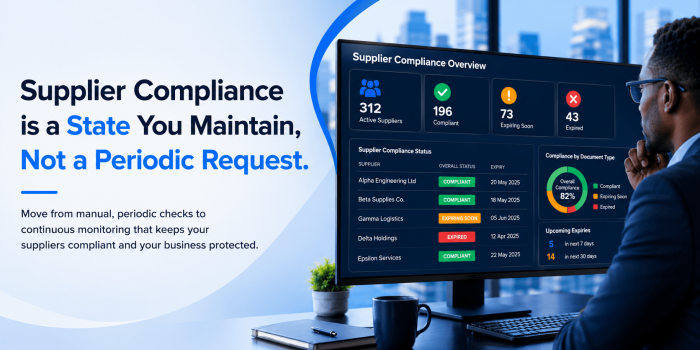
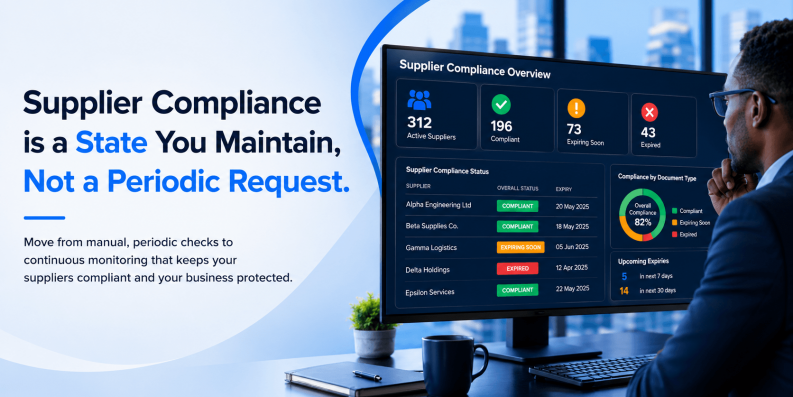
- The state lives on the document, not in someone’s memory. Every requirement carries a visible status when it’s valid, a warning as it nears expiry, a clear flag when it’s lapsed or missing. You read a supplier’s compliance at a glance instead of opening folders and squinting at dates. The condition is rendered, not inferred.
- The system watches the clock, and tells both sides. Each document has a validity window the system tracks automatically. As expiry approaches, it notifies the people who need to act – the supplier (“renew this before it lapses“) and the buyer (“this supplier’s certificate expires in 14 days“). The lapse is surfaced before it happens, not discovered in an audit months later. This two-sided notification closes the exact gap that the file-and-forget model leaves wide open.
- Bad evidence is caught at the door. Validation happens at upload: the system checks for the right document type and captures its validity dates, so an already-expired or incorrect file is flagged on entry rather than sitting in the record looking compliant. The state stays trustworthy because what enters it is checked.
- One living profile, shared by both parties. The supplier maintains a single, current profile, and buyer and supplier see the same live state. That removes the per-tender re-request, the email tennis, and the duplicate copies that drift out of date, and it gives the supplier both a reason and a place to keep themselves current.
- Policy becomes something the system enforces, not something people remember. Compliance state can gate what happens next: a non-compliant supplier triggers a warning (or a block) before an award or transaction proceeds. Where there’s a legitimate reason to proceed anyway, the override is deliberate, attributed and logged. Policy stops depending on whether a busy buyer happens to remember it, and exceptions become accountable rather than invisible.
- Checks are layered, and the record is immutable. Verification of the fundamentals sits at the base; additional policy checks such as ESG, sector-specific, internal risk, layer on top as your standards evolve, with standard and location-specific requirements resolving automatically. And the compliance state at each decision point is written into an immutable record, so you can show not only that a supplier is compliant now, but that they were compliant at the moment you awarded.
Why your ERP doesn’t solve this
Your ERP will happily store the certificate, but what it won’t do is manage the life of the relationship around it. And this is not a flaw but its job description as your system of record. Your ERP is built to hold the authoritative version of what happened. But the period before and around supplier selection – qualifying suppliers, defining what they must prove, keeping that proof current – is a system-of-action problem, and it lives largely outside the ERP’s reach. It’s the part of the process where the documents are gathered, the decisions are made, and the risk is actually created or contained.
This is the ungoverned space most organizations don’t realize they have; not the PO and not the ledger, but everything that should have been governed before the Contract existed.
What good compliance governance looks like
A compliance state worth maintaining is one where, on any given day, you can answer a single question without a scramble: is every supplier we’re transacting with currently meeting our requirements? If the answer lives in a folder of documents collected at various points in the past, you’re guessing. If it lives in a system that tracks the state continuously, flags lapses to both sides, and produces a defensible record by default, you’re not.
Compliance was never the documents. It’s the condition they were supposed to prove, and a condition has to be maintained, not filed in an ERP.
Scale is the governance layer for the pre-PO black box – the ungoverned sourcing and supplier-selection stage between an approved request and a raised purchase order. Your ERP is your system of record, while Scale is your system of action.